
American Ballads
and Folk Songs
Sung by Jim Gold
Scroll down to continue your adventure
Click on underlined words to hear songs
American Ballads and Folk Songs
Complete Collection
Cotton-Eyed Joe
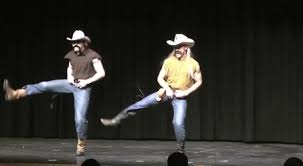 “Cotton-Eyed Joe:” a traditional American folk song with roots in the 19th century American South. It’s origins are linked to African American culture and themes of slavery, poverty, and hardship.
 The song’s title refers to the Cumberland Gap, a mountain pass in the Appalachian Mountains at the juncture of the states of Tennessee, Virginia, and Kentucky. The gap was used in the latter half of the 18th century by westward-bound migrants travelling from the original 13 American colonies to the Trans-Appalachian frontier. A version of the song appeared in the 1934 book, American Ballads and Folk Songs, by folk song collector John Lomax. Woody Guthrie recorded a version of the song at his Folkways sessions in the mid-1940s, and the song saw a resurgence in popularity with the rise of bluegrass and the American folk music revival in the 1950s.”.
“Down by the Riverside date back to before the American Civil War,[1] though it was first published in 1918. Because of its pacifistic imagery, “Down by the Riverside” has also been used as an anti-war protest song, especially during the Vietnam War.[1] The song is also included in collections of socialist and labor songs.[4]
Down in the Valley
Down in the Valley” is a traditional American folk song.[1] The verses mentioning “Birmingham Jail” refer to the Birmingham, Alabama, City Jail which was well-known in the mid-1920s. According to one biographer of the folk musician Lead Belly, he performed it for Texas Governor Pat Neff at the Sugarland Penitentiary in 1924.
“Drill, Ye Tarriers, Drill” is an American folk song first published in 1888 and attributed to Thomas Casey (words) and later Charles Connolly (music). This work song refers to the construction of the American railroads in the mid-19th century. The title refers to Irish workers, drilling holes in rock to blast out railroad tunnels. It may mean either to tarry as in delay, or to terrier dogs which dig their quarry out of the ground,[2] or from the French word for an auger, tarière. The song has been recorded by The Chad Mitchell Trio, The Weavers and Makem and Clancy, among many others.
“Low Bridge, Everybody Down” is credited to Thomas S. Allen (although its origin and authorship remain in question[1]), and first recorded in 1912,[2] was written after the construction of the New York State Barge Canal, which would replace the Erie Canal, was well underway, furthering the change from mule power to engine power, raising the speed of traffic. Also known as “Fifteen Years on the Erie Canal“, “Fifteen Miles on the Erie Canal“, “Erie Canal Song“, “Erie Barge Canal“, and “Mule Named Sal“, the song memorializes the years from 1825 to 1880 when the mule barges made boomtowns out of Utica, Rome, Syracuse, Rochester, and Buffalo, and transformed New York into the Empire State.
Haul Away Joe
A short-drag shanty so ubiquitous that its name is almost synonymous with the very term. While its first commercial recording of this sea shanty was by Huddie “Leadbelly” Ledbetter in the 1940s but its origins go back to the mid-19th century.
The origin of this well-known African American spiritual was probably composed on a plantation in the antebellum Deep South. Whatever its origin, the song was clearly inspired by the Old Testament tale of the fall of Jericho, from the Book Of Joshua. The Israelite army led by Joshua marched around the city blowing their trumpets – ram’s horns – and after Joshua ordered them to shout, the walls collapsed.
Got to pull this timber ‘fore the sun goes down,
Get it cross the river ‘fore the boss comes ’round,
Drag it down that old dusty road,
Come on, Jerry, let’s dunp this load,
cho: Hollerin’ timber! (timber!)
Lord, this timber’s gotta roll.
My old Jerry was an Arkansas mule
Been everywhere and he ain’t no fool.
Weighed nlne hundred and twenty-two,
Done everything a poor mule can do…
Jerry’s old shoulder was six foot tall,
Pulled more timber than a freight can haul,
Work got heavy, Ol’ Jerry got sore,
Pulled so much he wouldn’t pull no more…
Boss hit Jerry and made him jump,
Jerry reared up and kicked that boss in the rump,
Now my old Jerry was a good old mule,
If it had-a been me I’d-a killed that fool…
The boss he tried to shoot my Jerry in the head,
Jerry ducked the bullet and stomped him dead,
Stomped that boss till I wanted to scream,
Should have killed him myself, he was so danm mean.
Recorded by Josh White
source: https://www.lyricsondemand.com/u/unknownlyrics/timberjerrythemulelyrics.html
The African-American spiritual “Kum ba yah” (“Come by here”). an appeal to God to come to the aid of those in need, was first recorded by the folklorist Robert Winslow Gordon in 1926. The piece became a standard campfire song in Scouting and summer camps and enjoyed broader popularity during the folk revival of the 1950s and 1960s. In American politics, the song title gave rise to the phrase “sing Kumbaya“, depicting peaceful goals as compromises.
A beautiful song about a loyal dog and companion.”Old Blue“
“Oleanna” (or “Oleana“) is a Norwegian folk song that was translated into English and popularized by former Weavers member Pete Seeger. The song is a critique of Ole Bull’s vision of a perfect society in America. Oleanna was actually the name of one of Ole Bull’s settlements in the New Norway colony of Pennsylvania. His society failed, and all of the immigrants moved away, since the dense forest made it hard to settle there. The lyrics concern the singer’s desire to leave Norway and escape to Oleanna, a land where “wheat and corn just plant themselves, then grow a good four feet a day while on your bed you rest yourself.”[1]
The lyrics for Oleanna were written by Ditmar Meidell, a Norwegian magazine editor The song was first published on March 5, 1853, in Krydseren (The Cruiser), a satirical magazine which Meidell had founded.[3]
Theodore C. Blegen included the song in his 1936 book Norwegian Emigrant Songs and Ballads.Folksinger Pete Seeger learned Oleanna from Blegen’s book and in 1955 wrote a six-verse translation that was later published in Sing Out! magazine. In 1960 Theodore Bikel[5] and Alan Lomax[6] each published versions of Oleanna that drew on Seeger’s translation, Meidell’s original lyrics and their own imaginations. Jerry Silverman translated 19 of the 22 verses in 1992. Seeger recorded Oleanna twice for Folkways Records.[1][8] Among those who also covered his translation were Theodore Bikel,[9] Joe Glazer[10] and the Gateway Singers.[11] The Kingston Trio, however, released a version with lyrics unrelated to Meidell’s original text.[12]
I pup my whip and bring the blood
Make the leaders take the mud
We’ve got the wheels and we turn them around
One long hard pull and we’re on hard ground
To me rol to me rol to my rideo
To me rol to me rol to my rideo
To my rideo to my rideo
To me rol to me rol to my rideo
Within the month of October-o
I hitched my team in order-o
To try the hills of Salado
To me rol to me rol to my rideo
To me rol to me rol to my rideo
To my rideo to my rudeo
To me rol to me rol to my rideo
When I got there the hills were steep
Would make another person weep
To hear me cuss and crack my whip
And see the oxen pull and slip
To me rol to me rol to my rideo
To me rol to me rol to my rideo
To my rideo to my rudeo
To me rol to me rol to my rideo
Every night when the sun goes in (Repeat twice)
I hang down my head and mournful cry.
Refrain
True love, don’t weep, true love, don’t mourn (Repeat twice)
True love, don’t weep nor mourn for me,
I’m going away to Marble town.
I wish to the Lord that train would come (Repeat twice)
To take me back where I come from. Refrain
It’s once my apron hung down low (Repeat twice)
He’d follow me through both sleet snd snow. Refrain
It’s now my apron’s to my chin (Repeat twice)
He’ll face my door and won’t come in. Refrain
I wish to the Lord my babe was born,
A-sitting upon his pappy’s knee,
And me, poor girl, was dead and gone,
And the green grass growing over me. Refrain
A miller, a weaver and a tailor lived in King Arthur’s time (or in “Good Old Colonial times”). They were thrown out because they could not sing. All three were thieves. They are suitably punished.The earliest complete text is a broadside in the Bodleian Library, dated 1804, “The Miller Weaver and Little Tailor”.[1] It is also known as “In Good King Arthur’s Days”. It is known in the USA from the early nineteenth century, usually as “In Good Old Colony Days” or “In Good Old Colony Times.”[2]
Prior to the end of the US Civil War and emancipation, spirituals were originally an oral tradition passed from one slave generation to the next. Biblical stories were memorized then translated into song. Following emancipation, the lyrics of spirituals were published in printed form. Ensembles such as the Fisk Jubilee Singers—established in 1871—popularized spirituals, bringing them to a wider, even international, audience.
Woody Guthrie, Woodrow Wilson “Woody” Guthrie (July 14, 1912 – October 3, 1967), who wrote 900 Miles. was an American singer-songwriter and folk musician whose musical legacy includes hundreds of political, traditional and children’s songs, ballads and improvised works. He frequently performed with the slogan This Machine Kills Fascists displayed on his guitar. His best-known song is “This Land Is Your Land.” Many of his recorded songs are archived in the Library of Congress. Such songwriters as Bob Dylan, Phil Ochs, Bruce Springsteen, John Mellencamp, Pete Seeger, Joe Strummer, Billy Bragg, Jeff Tweedy and Tom Paxton have acknowledged Guthrie as a major influence. more »
900 MilesI am walkin’ down this trackI’ve got tears in my eyesI’m tryin’ to read a letter from my home An’ if this train runs me right I’ll be home Saturday night’Cause I’m nine hundred miles from my homeLord I hate to hear That lonesome whistle blow This train I ride on Is a hundred coaches longWell, you can hear her whistle blow A million miles An’ if this train runs me right I’ll see my woman on saturday night’Cause I’m nine hundred miles from my homeLord I hate to hear That lonesome whistle blow I will pawn you my wagonAnd I will pawn you my teamI will pawn you my watch and my chain An’ if this train runs me right I’ll be home Saturday night’Cause I’m nine hundred miles from my homeLord I hate to hear That lonesome whistle blowThat long lonesome train whistlin’ down
Jim Gold International
Folk Tours Schedule 2025
jimgold.com/folk-tour-schedule-2025/
Jim Gold International
497 Cumberland Avenue, Teaneck, NJ 07666 U.S.A.
web site: www.jimgold.com
Phone: (201) 836-0362
E-mail: jimgold@jimgold.com
